
We Wish You a Merry Christmas and a Happy New Year!
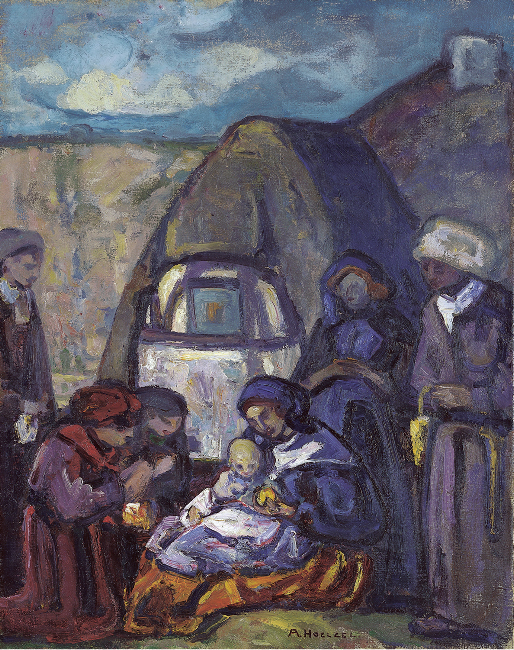
Our Christmas card this year is Adolf Hölzel’s Anbetung – Adoration (Nativity), 1912.
How the Government should take forward its family policy
The Prime Minister David Cameron set out on December 10 what he called “one of the biggest changes in our national culture for decades” namely changing from a society “that ignores the power of strong relationships, to one that values them” and “from one that undermines families, to one that strengthens them.”
This is important because “no one who wants to tackle some of our deepest social problems – and the massive economic costs they bring – has a hope unless they understand the importance of family.” (1)
The importance attached to the family strengthens the Relationships Foundation’s call for the Government to set out a strategy for the family with clear cabinet level leadership and a commitment to ensure that policy in all areas builds a more supportive environment for families – what we have called ‘Family Proofing’. (2)
Relationships Foundation Executive Director Michael Trend commented, “Only when responsibility for the family is strongly rooted at the working heart of government and family-proofing of policy becomes the norm can we begin to make progress towards becoming the most family-friendly country in Europe.”
“When the coalition government was formed we proposed to the Cabinet Office the core elements of a strategy for doing this. (3) We are delighted that many of these have been taken up.”
In our strategy for the family we called for:
- Family proofing of all policy. The promise that all departments will take a “long hard look at how government action can affect families and relationships” is a welcome step forward. We have set out a framework (4) for doing this and hope that the government will become increasingly relationally literate as well as economically literate.
- New overall measures of national progress that include social, as well as economic and environmental indicators. The new national measure of wellbeing is a good start and should provide clear evidence of the contribution of family relationships to our overall sense of progress.
- Recognition of relational poverty as well as material poverty in life chances. This is acknowledged in Frank Field’s review of poverty and life chances. (5) It is now important that where other specific policy goals are being reviewed these include assessments of the extent to which family relationships are either intrinsic elements of those goals, or important means to achieving them.
- A review of how government can influence the quality of family relationships. We welcome Frank Field’s proposal that the ‘nudge unit’ is tasked to examine “how parenting and nurturing skills can be promoted throughout society.” We recommended that the government should review more systematically how key factors such as time (6), finance (7) and place are affecting families and welcome the acknowledgement of these pressures in the Prime Minister’s speech.
- Address the motivation, opportunity and support for relationships. (8) The two specific areas where we called for intervention – couple relationship education (9) and increased support for the families of vulnerable early years children – are being addressed. (10)
As well as the need to clarify responsibility for the family within the Cabinet, there is one further issue that has not yet been addressed. The Prime Minister noted the importance of families for education, health, employment, welfare and community safety. We recommend that the Government tracks the capacity of family relationships to support desired policy outcomes more systematically, using this data to inform projections about future service demand pressures and outcomes. The future of social care, for example, will be significantly influenced by the family circumstances of older people and the willingness and capacity of family members (as well as friends and local community) to contribute to their care. Social norms about care responsibilities, as well as the opportunity and capacity to exercise them, are as important as tracking demographic changes. The Chancellor will set out a financial budget. Real progress needs a social budget as well. (11)
Inaugural Meeting of the International Council of Relationships Global
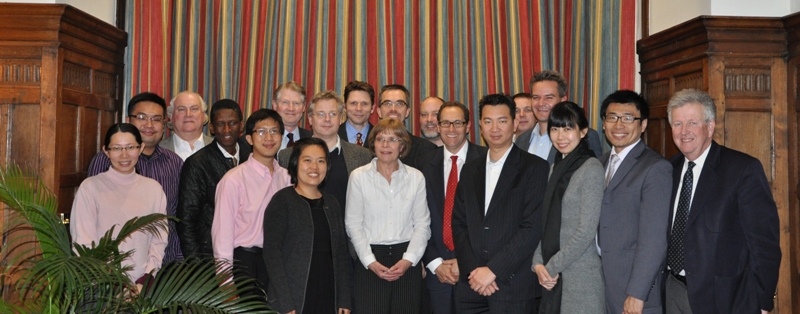
The International Council of Relationships Global pictured at their inaugural meeting at St Catharine’s College, Cambridge. Delegates came from South Africa, Singapore, Malaysia, Hong Kong, US, Australia and the UK
RF response to the report of the Independent Review on Poverty and Life Chances by Frank Field
In welcoming the report of the Independent Review on Poverty and Life Chances by Frank Field (1), the Relationships Foundation notes with interest his call for the appointment of a Cabinet Minister for Foundation Years at the next reshuffle. The Relationships Foundation, however, remains adamant that we would rather see a Cabinet Minister for families to ensure a more integrated family policy.(2)
In our submission to Frank Field’s review we emphasised the importance of relational as well as material poverty. We therefore welcome his comment that “I no longer believe that the poverty endured by all too many children can simply be measured by their parents’ lack of income. Something more fundamental than the scarcity of money is adversely dominating the lives of these children.”
The report calls for both national and local Indicators of Life Chances. These assessments will track how the government is performing in its goal of “raising the cognitive and non-cognitive skills of poorer (pre-school) children”. Alongside the newly announced national measure of wellbeing, this will make it all the more important that government policy supports those family relationships that are the foundation of both wellbeing and healthy development.
Maternal depression is one indicator that might well appear in both measures. The latest analysis of the millennium cohort study notes the lower levels of depression for married mothers and the much higher levels of reported depression “among solo mothers who had periods of time living with a partner but had reverted to being a lone parent at the time of the 5 year old survey.” (3) This illustrates why support for families must be an essential foundation for the government’s wider goals.
The report also emphasises the importance of authoritative parenting. Frank Field comments in the report that “Britain is witnessing a rupturing in its once strong parenting tradition.” We support his call for the Cabinet Office’s Behavioural Insight Team to lead “an examination of how parenting and nurturing skills can be promoted throughout society”.
Relationships Foundation welcomes national measure of wellbeing
In welcoming the Prime Minister’s commitment on November 25 to develop a national measure of wellbeing, the Relationships Foundation is calling for robust mechanisms to consider how policy in all areas fosters and protects the relationships and social connections that are widely recognised as the most significant determinants of wellbeing
In his speech today David Cameron acknowledged that
Every day, Ministers, officials, people working throughout the public sector make decisions that affect people’s lives. This is about helping to make sure those government decisions on policy and spending are made in a balanced way, taking account of what really matters. I’ve said before that I want every decision we take to be judged on whether it makes our country more or less family-friendly – and this new focus on well-being will be part of achieving that. (1)
We are much-heartened that this picks up on many of the recommendations of our pre-election report, A Relationships State of the Nation. (2)
We have been encouraged by David Cameron’s recognition of the importance of relationships for wellbeing since his address to the Google Zeitgeist conference four years ago:
Well-being can’t be measured by money or traded in markets. It can’t be required by law or delivered by government. It’s about the beauty of our surroundings, the quality of our culture, and above all the strength of our relationships… What makes us happy, above all, is a sense of belonging – strong relationships with friends, family and the immediate world around us. (3)
This is backed up by strong academic support. For example, Professor Robert Helliwell has written with Robert Putnam that:
Social connections, including marriage, of course, but not limited to that, are among the most robust correlates of subjective well-being. People who have close friends and confidants, friendly neighbours and supportive co-workers are less likely to experience sadness, loneliness, low self-esteem and problems with eating and sleeping. Indeed a common finding from research on the correlates of life satisfaction is that subjective well-being is best predicted by the breadth and depth of one’s social connections. (4)
A Relationships State of the Nation, a flagship pre-election report we published in March, brings together a number of themes from the Relationships Foundation’s work on wellbeing and relationships over the past year. It makes the case that as we look ahead to the next five or ten years we will want to see more than just economic growth. The state of public finances means that continuing progress cannot simply be bought through government spending. New methods and new measures are needed. Over the past year the RF has set out how policy in many areas influences the motivation, opportunities and support for the relationships that are important for wellbeing (5, 6).
Since the election we have been critical of the coalition government’s failure to give a strong voice to the family at the heart of government. Michael Trend, Executive Director of the Foundation has commented that:
While there is much merit in refocusing the Department of Children, Families and Schools on its original role as the Department for Education, losing Family from any Cabinet minister’s primary responsibility is surely a problem for a Government so committed to families. Without a champion at the heart of government, the family-friendly agenda is unlikely to succeed. There needs to be top-level leadership on the family and family policy should have a central role in government.
We hope that today’s commitment to measure wellbeing signals that the government will give the serious attention to the impact of policy on relationships that we have advocated so strongly.
Getting relationships right is arguably the most important agenda in public policy, public services, business, communities and in our personal lives. We know what is needed. Our understanding of how to do it is improving. Let’s make sure debate is informed by an illuminating picture of what’s going on. In such a way we, as a country, can learn to have a better understanding of the advantages of trust, commitment and neighbourliness, and the life-destroying qualities of loneliness, distrust and social breakdown.
RF on the radio
John Ashcroft, our Research Director did 8 interviews on Sunday, 28 November, for BBC on the national measure of wellbeing.
Listen to the recording below:
Thank you for reading our newsletter! If you enjoy hearing news from us, and would like to help us find new supporters, please forward this email to a friend. Why not
suggest that they subscribe to it too? See the green “Stay in Touch” button on our website.
Sincerely,
The Relationships Foundation