
Tax breaks, first time buyer and mortgage interest support and fuel duty changes may benefit families in the short term: but it won’t relieve the long term pressure on families, or stem the tide of family breakdown.
Using purchasing power parity, on Eurostat data, UK energy costs have been among the lowest in Europe, and UK food costs around the average, although fuel costs are no doubt rising from their 2009 level of 5% of household budgets, and food inflation is rising at 6.3% compared with a Eurozone average of 1.5%. But, though inflation and world events are adding to immediate pressures, there are longer-term, structural pressures on UK families:
• 13.9% of UK households with dependent children have household debt more than 100% of their monthly disposable income. This is the highest in Europe, equal with Germany (Eurostat, latest data 2008).
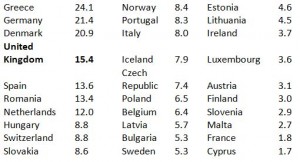
• 15.4% of UK households with dependent children experience housing cost overburden, the fourth highest in Europe (Eurostat, latest data 2009).
Britain languishes at the bottom of almost every European league table relating to family pressure. The Prime Minister has repeatedly committed to make Britain Family Friendly, the Deputy Prime Minister has claimed not to be ‘casual’ about the pressure on parents.
The annual £42 billion cost of family breakdown due to its impact on benefits, crime, health and education, operates like an additional interest payment on the legacy of the past. But we continue to run a families deficit because family breakdown is increasing. Over the last ten years, there has been a 20% increase in the likelihood that a newborn’s parents will split by her 16th birthday.
One in twelve households has experienced relationship problems as a result of financial difficulties.
The Government has failed to set out a strategic plan for reversing this trend. The Childhood and Families taskforce, which Nick Clegg claimed would influence this budget, has been completely silent.
Commenting, Michael Trend, Executive Director of the Relationships Foundation, said:
“It is hugely disappointing that the Childhood and Families taskforce has had no impact on this budget, and that the question of how to make Britain family friendly was neglected.”
“Employment is the crucial route out of our social and economic problems, but David Cameron will repeat the mistakes of the past if he drives the economy at the expense of family and community.”
“Even as George Osborne tries to save money, family breakdown is costing taxpayers £42 billion and rising: the Government has a strategy for growth which supports families – now it needs a strategy for families to support growth.”
Notes to Editors
• There were a number of European comparisons deployed in the budget – but not the European comparison pledge of making Britain the most family friendly country in Europe.
• The budget documents barely mention family, and do not reference the pledge.
Calls for a family friendly budget
• Jill Kirby, writing on Conservative Home today, has said “George Osborne needs to think of families as engines of growth. It would be great to hear him outline a pro-family fiscal policy with clear incentives for work and family stability, not just to ease the burden on today’s families but to create social and economic capital for the future.”
• There is mounting criticism of the Government’s failure to deliver on its pledge to make Britain family friendly:
o October 2010 Tim Montgomerie wrote in the Times (£) that ‘family policy has run into the sands’ because of the Liberal Democrats.
o February 2011 Peter Oborne accused Cameron of ‘caving in to those waging war against the family’
o March 2011 The Daily Express calls the Taskforce a ‘fiasco’.
o March 2011 Harry Benson, who addressed the 2009 Party Conference where he ‘utterly appluaded’ David Cameron’s approach to marriage asks ‘where is the family policy?’
o March 2011 Ruth Porter of the Institute of Economic Affairs argues that the family is a crucial – and oft-forgotten – element of the Big Society
Government pledges
• After the coalition agreement was signed, David Cameron wrote in the Daily Mail ‘making Britain more family-friendly is still a crucial objective of this coalition government. We’re committed to recognising marriage in the tax system, taking action on the couple penalty in the tax credit system and increasing the number of Sure Start health visitors to give parents the help they need.’(21 May 2010)
• As recently as January, Nick Clegg told Demos ‘We are not casual about the pressure that many parents feel’, and he recognised that ‘Financial hardship, the stress and conflict it causes, can be hugely disruptive for families’.
Government inaction
• Childhood and Families Taskforce
o The Childhood and Families Taskforce was announced during a speech to Barnados in June 2010 by Deputy Prime Minister Nick Clegg. He revealed that David Cameron would be chairing the Taskforce. Nick Clegg said the ‘work will be completed over the autumn, and the proposals will be developed in the context of the upcoming Spending Review’. The Guardian reported that it would ‘report its conclusions around the end of the year’. The taskforce would be attended by Work and Pensions Secretary Iain Duncan Smith, children’s minister Sarah Teather, science and universities minister David Willetts, public health minister Anne Milton and economic secretary to the Treasury Justine Greening.
o Gavin Shuker MP asked the Prime Minister when it met, who attended, to see the Terms of Reference, when it would report and what evidence it had taken. He was referred to Jon Trickett’s PQ :
Jon Trickett: To ask the Prime Minister on how many occasions the Childhood and Family Task Force has met to date; and who attended each such meeting. [22371]
The Prime Minister: The Childhood and Families Task Force was created in June 2010. The role of this group is to identify and prioritise a small number of specific policy proposals that will make the biggest difference to children and families. It is longstanding Government practice not to disclose information relating to ministerial meetings, including the proceedings of Cabinet and Cabinet committees, as to do so would put at risk the public interest in the full and frank discussion of policy by Ministers.
8 Nov 2010 : Column 24W
o The list of Cabinet Office Committees is here: it does not include the ‘Childhood and Families Taskforce
• Flexible working
o Despite being a pledge from 2006 for the Conservatives, repeated in the Manifesto, echoed in the Liberal Democrat manifesto, and contained in the Coalition agreement, the government last week backtracked on its pledge to extend flexible working by April 2011.
o This is also despite an Impact Assessment in BIS which found that extending the right to parents of 17 year olds would be of £20 million net benefit over 10 years. In June last year, the Minister, Ed Davey announced a consultation for ‘later in 2010’. It never happened.
o Furthermore, BIS was working on these proposals with the Childhood and Families taskforce:
Growing pressures
• In 2007, a UNICEF report revealed that the UK had the worst child well-being in the OECD. That we do worst against our European neighbours is backed up by Eurostat (EU) data:
• Households with dependent children with household debt more than 100% of its monthly disposable income, 2008 (%).
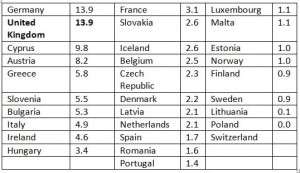
• NB: According to Eurostat the amount owed in arrears was recorded for: housing bills/repayment, consumption loan/credit repayment and other non housing bills. In addition, the outstanding amounts were recorded for: bank overdrafts and credit and/or store card(s) unbalanced. Although the scale was not strictly additive it was possible to characterise the overall degree of the household financial difficulties when aggregating the different dimensions. For instance, a household can be said to be in a ‘critical’ situation with respect to arrears if the household had a debt higher than its monthly disposable income in one dimension or in the combination of various dimensions. The amount of the mortgage itself is not taken into account, only the arrears related to the payment of the mortgage are included.
• Households with dependent children experiencing housing cost overburden, 2009 (% of total population).
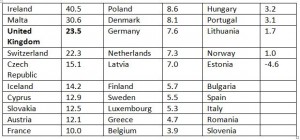
• As of 2004 we had the third highest childcare costs as a percentage of family income, 23.5% (Eurostat, latest data 2004). Average of net childcare costs for dual earner and lone parent families, 2004 (% of family income).
• Financial pressure can lead to relationship problems and relationship breakdown:
o One in twelve households had experienced relationship problems as a result of financial difficulties. (Kempson, E. (2002) Over-indebtedness in Britain: A report to the Department of Trade and Industry).
o The Legal Services Research Centre found ‘Debt problems can bring about ill-health, relationship breakdown and loss of employment’ and be ‘particularly distressing impacts on parents’ relationships with their children.’ (Pascoe Pleasance, et al. “A Helping Hand: The impact of debt advice on people’s lives” 2007).
o 27% of couples regularly argue when they try to discuss their finances (FSA 2006).
o 10.7 million people suffer relationship problems because of money worries (YouGov).
• A report by Harry Benson and the CSJ found that nearly 1 in 2 children (48%) born today will see their parents split. This is up from 40% of children born 10 years ago.
• Family breakdown costs the UK taxpayer around £42 billion a year. Tobacco costs £13.74 billion (Policy Exchange); alcohol abuse costs between £20-£25 billion (DH figures).
For further information, please contact John Ashcroft, Research Director, on 01223 909 408, or j.ashcroft@relationshipsfoundation-org.stackstaging.com